Wetland Connection
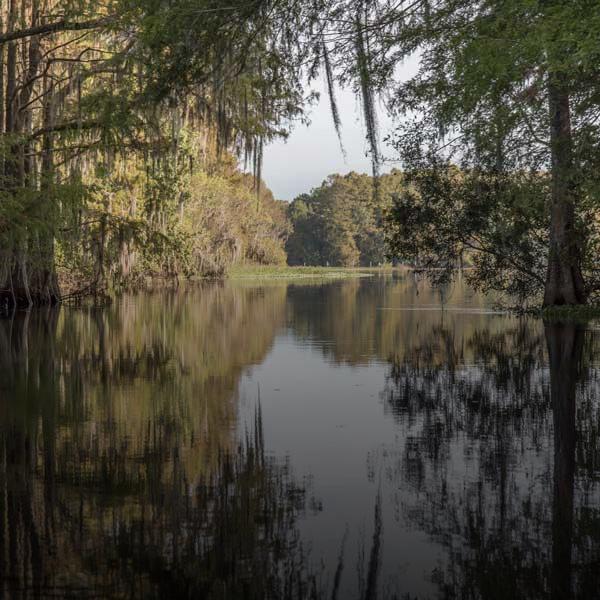
Visualize a cypress swamp where under the trees' thick canopy, day becomes night, where murky standing water covers the ground, where cypress knees poke out from under the water's surface, and where the humming of insects completes the swamp's eerie atmosphere.
Or imagine a coastal marsh where seagrasses wave in the breeze, where shore birds fly overhead, and where tides affect whether the land is wet or dry over the course of a day.
As different as cypress swamps and coastal marshes are, both are wetlands. By definition, a wetland is an area where water saturates the soil for several months each year, usually during the growing season. While all wetlands in Florida have this in common, wetlands vary drastically in appearance, plant and animal habitat value, and other characteristics.
In the Southwest Florida Water Management District, there are five primary wetland types:
- Coastal marshes
- Mangrove swamps
- Freshwater marshes and wet prairies
- Cypress swamps
- Hardwood swamps
Understanding that each type of wetland is fragile, the District promotes the conservation of wetlands. On one level, the District regulates what kinds of human activities and development can take place in existing wetlands. The District also acquires sensitive tracts of wetlands through state programs such as Save Our Rivers and Preservation 2000. The aim of these acquisitions is to protect the land for the water's sake. In this fact sheet, you will learn about the various types of wetlands you can see throughout the District.
Mangrove Swamps
- The mangrove trees that make up these swamps form along the Gulf. They are frequently found near coastal marshes.
- Red mangroves form closest to the gulf and have the most exposure to salt water.
- Black mangroves are further inland but are filled with sea water at high tide.
- White mangroves are the furthest inland and have the least influx of salt water.
- Mangroves contribute to the productivity of bordering estuaries. Leaf fall provides food for countless organisms ranging from bacteria to large fish.
- Many of the mangrove swamps are owned by the government and are well protected.
Freshwater Marshes
- Unlike coastal marshes, these wetlands rely on fresh water.
- The plants here are usually wetland grasses, rushes or sedges. You will also find green, non-woody shrubs growing in communities. Few trees grow in marsh conditions.
- Different locations may have marshes dominated by sawgrass, cattails, spike rush, bulrush, and maidencane.
- The soil in these wetlands is saturated during at least one month per year during the growing season. These marshes (also called wet prairies) often give the appearance of an overgrown field. Grasses, rush and sedge grow in wet prairies.
- Fire and flooding squeeze out the plants and trees that don't belong in these areas.
- Drainage for agriculture is the main reason for marsh losses.
- The marshes that remain are mostly unsuitable for agriculture or are protected under wetland regulations.
Cypress Swamps
- These wetlands usually occur where slow-moving or still water is present most of the year.
- Cypress trees grow out of standing water.
- "Bald" cypress swamps form along rivers or lake margins; "Pond" cypress swamps appear mixed in with upland forests and prairies.
- The soils are flooded from four to eight months a year.
- The soil drains slowly.
- Fire helps keep other trees from establishing themselves here. After a fire, the cypress trees quickly grow back.
- Cypress swamps are protected under conservation laws.
Hardwood Swamps
- You'll often find these wetlands near lakes and rivers.
- Sometimes hardwood swamps overlap with cypress swamps.
- These are forested wetlands that feature mostly deciduous hardwood trees.
- Prolonged flooding of bordering rivers keep the forest floor submerged for part of the year. If this type of system is either drained or flooded for a long period of time, a new type of community will result. Therefore, this is a highly sensitive area.
- Trees consist largely of water tupelo, Carolina ash, and blackgum. You may also find red maple, sweetgum, and water hickory. Slightly more upland, you may find swamp chestnut oak.
- Bay swamps (also known as bayheads), are hardwood swamps where broad-leaf evergreen trees are the dominant plant species. The tallest trees may often be pines. These communities occur on level or gently sloping land or in depressed areas. Seepage water from upland areas keeps the bay swamps almost constantly wet.
- Hydric hammocks are upland, drier versions of hardwood swamps. These contain a mixture of broad-leafed evergreen and deciduous trees. Cabbage palmettos are often found here. Hydric hammocks are seldom flooded but have saturated soils much of the year.
Vocabulary
Here is a list of some of the words you will need to know in order to make learning about wetlands easier.
- Brackish water
- A mixture of salt water and fresh water found in estuaries and vital to estuary ecosystems.
- Deciduous
- The kind of trees that lose their leaves once a year. Opposite of evergreen.
- Ecosystem
- A community of living organisms.
- Estuary
- The area where a river empties into sea water.
- Evergreen
- The kind of trees that keep their leaves year round. Opposite of deciduous.
- Hardwood
- Slow-growing flowering trees with broad leaves.
- Salinity
- A word describing the salt content of a liquid.
- Saturated
- A condition in which soil has absorbed as much water as it can physically hold.
- Tides
- Changes in water level due to the gravity of the sun and moon.